
News and Insights
Question 3 Asks One Thing. Here’s How to See Through the Spin.
|
On November 3, Massachusetts voters will decide Question 3 to bring All-Party Primaries to state elections. In the final weeks before Election Day, political insiders and operatives are working hard to confuse voters about what it does. Let’s take a closer look at the one question Question 3 actually asks, and the three tactics being used to distract from it.
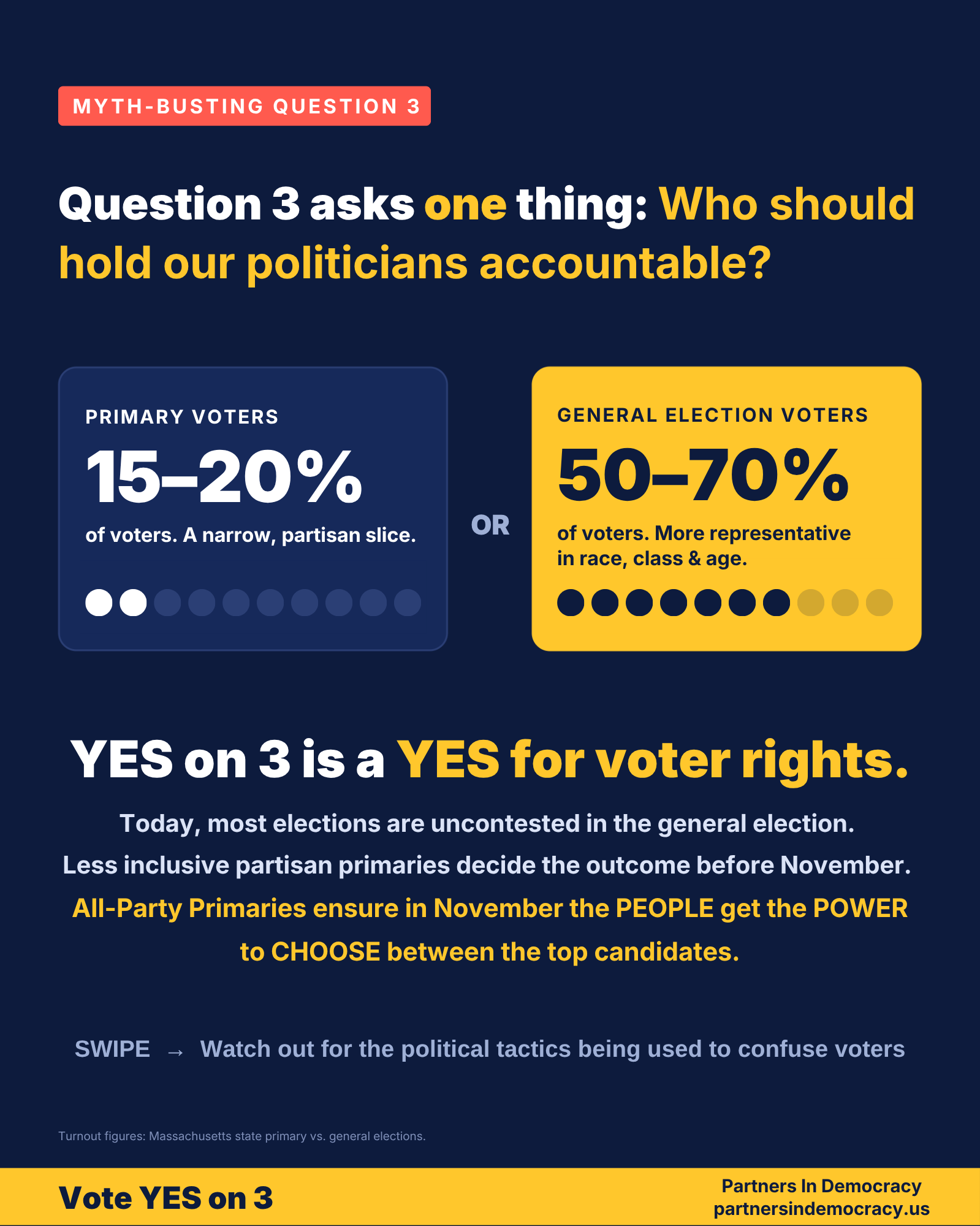
Question 3 asks one thing: Who should hold our politicians accountable?
Right now, the real decision in most Massachusetts races happens in a September partisan primary, when only about 15-20% of voters turn out. Question 3 moves the deciding contest to November, when 50-70% of voters cast a ballot. That November electorate is not just larger – it’s more representative of Massachusetts in race, class, and age. Voters under 35 and Latino voters, for example, make up roughly twice as large a share of the general electorate as they do of the primary electorate.
A YES on 3 is a YES for voter rights. It gives the power to choose our leaders to the people closest to the problems.
How partisan primaries decide races before November
Massachusetts has the least competitive state elections in the country. In 2024, 61% of Massachusetts elections were uncontested. When only one party fields serious candidates, the primary is the decisive election, and the small group of voters who show up in September makes the decision for everyone.
An example: the First Suffolk State Senate race
Last month, incumbent State Senator Nick Collins and challengers Latoya Gayle and Juwan Skeens faced off in the Democratic primary for the First Suffolk State Senate seat. It was one of the most closely watched legislative races in the state. Collins won with 11,276 votes (53.9 percent) to Gayle’s 9,105 (43.5 percent) and Skeens’ 506 (2.4 percent), out of 22,216 ballots cast in the race.
No other candidates are on the November ballot, so that September primary decided who will represent the district. For comparison, 78,815 voters cast a ballot in this same State Senate race in the November 2024 general election. About 11,000 votes chose the senator for a district before ~80,000 people get the chance to vote in November.
Under an All-Party Primary, every candidate would appear on one September ballot, open to every registered voter regardless of party. The top two finishers would advance to November.
In a race like this one, both leading candidates would have moved on, and the final choice between them would have been made by the full November electorate.
This is not about who should have won. It is about who gets to decide.
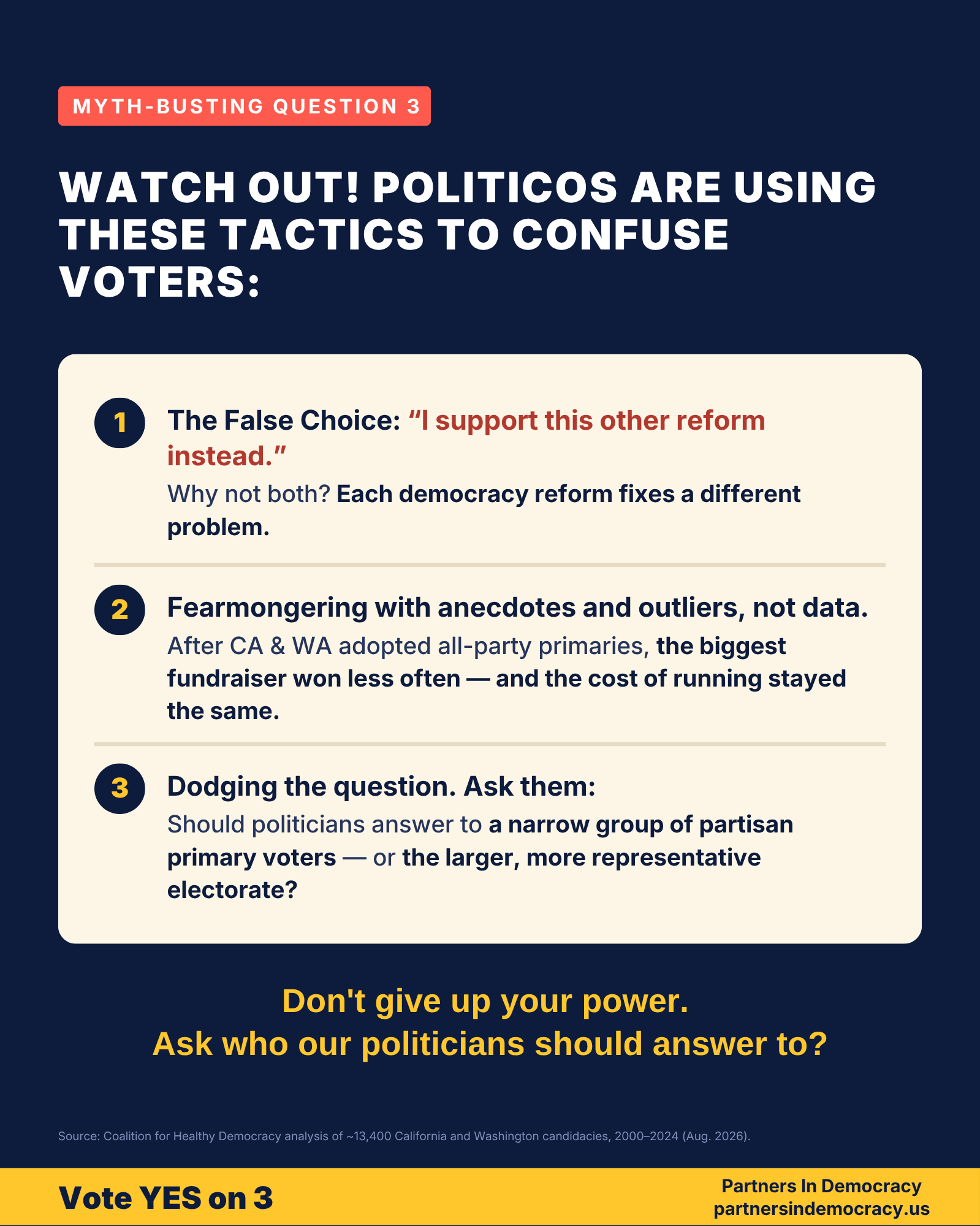
Watch out for the spin
Spin #1: The false choice
You may hear: “I support ranked choice voting instead.” Our answer: Why not both? Each democracy reform fixes a different problem.
Ranked choice voting addresses vote splitting. Vote splitting happens when several candidates divide the vote and someone wins with a small share of it. It is a problem under our current system: Lori Trahan in 2018 and Jake Auchincloss in 2020 each won crowded congressional primaries with about 22% of the vote. Vote splitting is an issue in our status quo and will continue to be an issue until we implement ranked choice voting.
All-Party Primaries address a different problem: Low-turnout partisan primaries deciding the outcome before general election voters get to weigh in. Ranked choice voting on its own does not change how few people vote in September or how many races are effectively decided by the narrow primary electorate.
Partners In Democracy supports ranked choice voting. Most cities and towns in Massachusetts use a nonpartisan or all-party primary election system. We are backing efforts to add ranked choice voting, but the Legislature refused to act on requests from most cities and towns to do so. All-Party Primaries and ranked choice voting complement each other. This is the first step to bring more accountability and responsiveness from our Legislature.
Spin #2: Fearmongering with anecdotes and outliers
The data from the states that already use All-Party Primaries is clear. After California and Washington adopted All-Party Primaries, money became less influential in who wins. An analysis of more than 13,000 candidacies in contested state and federal races from 2000 to 2024 found:
- A clear fundraising lead (1.5 to 3 times the runner-up) used to win about 9 races in 10. Today that same lead wins about 3 in 4.
- Winning did not get more expensive. Legislative races cost about the same as they did twenty years ago, adjusted for inflation, and the median winning California statewide campaign fell from $5.7 million to $3.0 million.
Massachusetts also starts with significantly stronger fundraising protections than California, including a $1,000 contribution limit (compared to California’s $80,000) and our ban on direct corporate contributions.
Spin #3: Dodging the question
Political insiders and operatives are doing everything they can to avoid answering a central question: Should politicians be accountable to a narrow group of partisan primary voters, or to the larger, more representative general electorate?
Insider-driven partisan primaries work well for incumbents – the people who already hold power in them. In a low-turnout September election, party insiders and networks carry outsized weight.
Question 3 asks those insiders to hand that power back to the people.
When you hear the spin, ask: Who should our politicians answer to?
Vote YES on 3 on November 3
Question 3 gives every voter a real voice in choosing who represents them. Share the graphic above with your friends and neighbors, and on November 3, vote YES on 3.
 Back to Newsroom